


Plaquenil 200 mg 60 tablets

Prednisolone 5mg 100 tablets

Sialis 5 mg 14 tablets

Semax nasal drops 0.1% 3 ml


Tamiflu 75 mg 10 capsules

Actovegin 200 mg 50 tablets

Ingavirin 90 mg 10 capsues


Ovestin 2 mg 30 tablets

Ovestin Vaginal cream 15g


Ventolin nebula 20 ampoules


Avodart 0,5 mg 90 capsules
- Antibacterial medication
- Antifungal medication
- Antiviral Medication
- Cardiovascular medication
- different medication
- Hormonal medication
- Immunosuppressants and immunomodulating medications
- Nervous system
- Pain relievers and anti-inflammatory
- Respiratory system
- Treatment of diseases of the liver and gastrointestinal tract
- Treatment of sensory organs, eyesight and hearing
- Urogenital system


De-Nol 120mg 112 tablets

De-Nol 120mg 56 tablets

De-Nol 120mg 32 tablets

finasteride 5mg 30 tablets

Itrazole 100 mg 42 capsules

furasol 15 sachets of 100 mg

Triacort OINTMENT 0.1% 10G


Urseptia 200 mg 20 capsules


Minolexin 50 mg 20 capsules


Immard 200 mg 30 tablets

Adenuric 120 mg 28 tablets


Champix 1 mg 112 tablets



Combilipen 30 tablets

Mexidol 2 ml 10 vials

Lamolep 25 mg 30 tablets

Memoplant 80 mg 30 tablets

Stugeron 25mg 50 tablets

neyrobion 3 ml 3 vials


Persen 60 tablets


Vasobral 30 tablets

Mirapex 1 mg 30 tablets


Noben 30 mg 30 capsules

Pronoran 50 mg 30 tablets

Actovegin 10 ml 5 vials

Cavinton 5 ml 10 vials

Novo-passit 10 tablets

Betahistine 24 mg 60 tablets


betaserc 24 mg 20 tablets

Persen night 10 capsules

Mydocalm 1 ml 5 vials

Biloba 40 mg 60 capsules

Picamilon 20 mg 30 tablets


Mexidol 125 mg 50 tablets
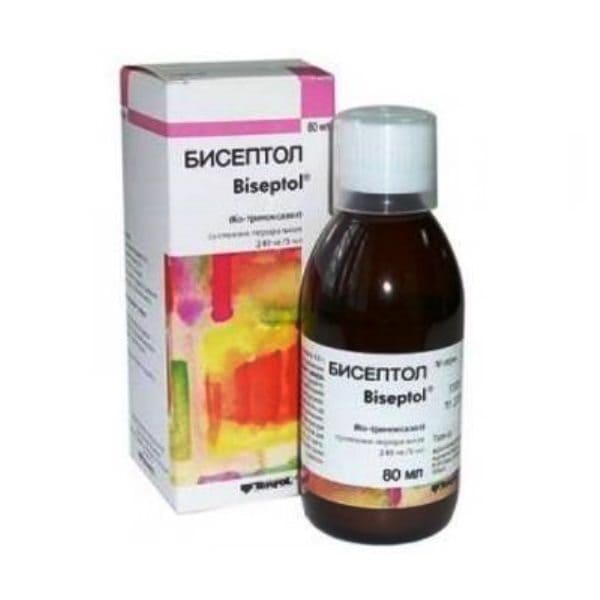
Biseptol 80 ml

Manufacturer: Medan Pharma Joint Stock Company
Country of origin: Poland
General description: Antibacterial sulfanilamide preparation

Pharmacological action
Co-trimoxazole is a combined antimicrobial drug consisting of sulfamethoxazole and trimethoprim in a 5: 1 ratio.
Sulfamethoxazole, similar in structure to para-aminobenzoic acid (PABA), disrupts the synthesis of dihydrofolic acid in bacterial cells, preventing the incorporation of PABA into its molecule. Trimethoprim enhances the action of sulfamethoxazole, disrupting the reduction of dihydrofolic acid into a tetrahydrofolic - active form of folic acid, responsible for protein metabolism and division of the microbial cell.
Both components, thus, violate the process of the formation of folic acid, necessary for the synthesis by microorganisms of purine compounds, and then of nucleic acids (RNA and DNA). This breaks the formation of proteins and leads to the death of bacteria. In vitro is a broad-spectrum bactericidal drug, however, the sensitivity may depend on the geographical location.
Typically, sensitive infectious agents (a minimum inhibitory concentration (MIC) of less than 80 mg / l for sulfamethoxazole): Moraxella (Branhamella) catarrhalis, Haemophilus influenzae (beta-lactamase-forming and beta-lactamase-forming strains), Haemophilus parainfluenzae, Escherichia coli (including enterotoxigenic strains), Citrobacter spp. (including Citrobacter freundii), Klebsiella spp. (including Klebsiella pneumoniae, Klebsiella oxytoca), Enterobacter cloaceae, Enterobacter aerogenes, Hafnia alvei, Serratia spp. (including Serratia marcescens, Serratia liquefaciens), Proteus mirabilis, Proteus vulgaris, Morganella morganii. Shigella spp. (including Shigella flexneri, Shigella sonnet). Yersinia spp. (including Yersinia enterocolitica), Vibrio cholerae, Edwardsiella tarda, Alcaligenes faecalis, Burkholderia (Pseudomonas) cepacia, Burkholderia (Pseudomonas) pseudomallei.
Likewise, Brucella spp. Listeria monocytogenes, Nocardia asteroides, Pneumocystis carinii, Cyclospora cayetanensis may be sensitive.
Partially sensitive pathogens (IPC 80-160 mg / l for sulfamethoxazole): coagulase-negative strains of Staphylococcus spp. (including methicillin-sensitive and methicillin-resistant strains of Staphylococcus aureus). Streptococcus pneumoniae (penicillin-sensitive and penicillin-resistant strains), Haemophilus ducreyi, Providencia spp. (including Providencia rettgeri), Salmonella typhi. Salmonella enteritidis, Slenotrdphomonas maltophilia (formerly called Xanthomonas maltophilia), Acinetobacter Iwoffii, Acinetobacter baumanii, Aeromonas hydrophila.
Stable pathogens (MIC of more than 160 mg / l for sulfamethoxazole): Mycoplasma spp., Mycobacterium tuberculosis, Treponema pallidum, Pseudomonas aeruginosa.
If the drug is prescribed empirically, it is necessary to take into account local characteristics of resistance to the drug of possible pathogens of a specific infectious disease. In infections that can be caused by partially sensitive microorganisms, it is recommended that the sample be tested for sensitivity in order to exclude the resistance of the pathogen.
Indications
Infectious-inflammatory diseases caused by microorganisms sensitive to the preparation:
- respiratory tract infections: chronic bronchitis (exacerbation), pneumocystis pneumonia (treatment and prevention) in adults and children;
- ENT-organs infections: otitis media (in children);
- infections of the urino-genital organs: urinary tract infection, mild chancroid;
- Gastrointestinal infections: typhoid fever, paratyphoid, shigellosis (caused by sensitive strains of Shigella flexneri and Shigella sonnei);
- travelers' diarrhea caused by enterotoxic strains of Escherichia coli, cholera (in addition to replenishment of fluid and electrolytes);
- other bacterial infections (possible combination with antibiotics): nocardiosis, brucellosis (acute), actinomycosis, osteomyelitis (acute and chronic), South American blastomycosis, toxoplasmosis (as part of complex therapy).
 .


 .